Chapter 7 - WHAT MY MOTHER LEFT BEHIND
The safe-deposit box opened on a Tuesday morning. Isabel stood beside me while the bank officer checked the probate order. Inside were three folders, a small velvet pouch, and a photograph of my mother sitting on the workshop floor with a chair frame balanced across her knees. She looked young and fiercely happy. I held the photograph for a long time before opening the folders.
The first contained patent-related correspondence and design registrations. The second held royalty statements, with handwritten notes showing the payments my mother believed she was owed. The third contained letters between Lucía and Arturo, including one in which Arturo acknowledged that the company had agreed to place disputed payments into a protected account while they resolved their disagreement. There was no evidence in the box that the promised account had ever been established.
The velvet pouch held a tiny brass hinge. My mother had engraved her initials inside it. I recognized the shape from the chairs Rosa had shown me at the factory. The hinge was an early prototype of the modular joint. It was worth almost nothing as metal, but it told the story of how she had worked: she had built things with her hands before anyone put a price on them. I put it back in the pouch, afraid I might lose it.
One letter stopped me. My mother wrote that Guillermo had offered to settle the royalty dispute if she signed a confidentiality agreement and surrendered all future claims. She refused because the amount did not match the records. She also worried that the settlement would prevent me from learning what had happened. "I don't want Natalia to inherit a fight," she wrote, "but I will not leave her a lie." I had spent years thinking she avoided the subject because she had been ashamed. In fact, she had been protecting me while trying to keep the truth alive.
Isabel arranged for independent experts to compare the originals with the scanned settlement Guillermo's lawyers had produced. Their preliminary findings identified inconsistent paper texture, signatures lifted from different source documents, and metadata indicating that the scan had been assembled much later than claimed. None of that was a final court ruling, but it was enough to justify further inquiry. The investigators also traced the false account in my name to an identity packet assembled from copies of my old employment documents.
I remembered filling out those forms when I worked briefly for a catering company that serviced Lombardo events. My mother had been dead less than a year. I was young, grieving, and grateful for any shift. The idea that someone might have used those documents to impersonate me made me feel exposed in a way I could not explain. Isabel helped me report the identity misuse and take practical steps to protect my credit and accounts. It was not glamorous work. It was necessary.
Renato came to the office with one more confession. He had discovered that a payment from Horizonte Cultural went to a consulting firm owned by Ximena's cousin. The firm had invoiced the foundation for community outreach that no one could verify. Renato had approved a related marketing contract because Ximena told him it was part of their wedding planning. "I wanted to believe her," he said. I told him belief was not the same as checking. He agreed.
When the forensic accountant examined those invoices, she found links to the same holding company that held the digitized design portfolio. The network of transactions was more complicated than a single stolen royalty check. It appeared to use charitable events, consulting fees, and secured loans to move money between related parties. Investigators would need to determine which transfers were illegal and who knew what. I began to understand why Isabel insisted on patience: every line of the ledger opened another door.
At home Teresa helped me try on the restored dress. The conservator had repaired the torn shoulder with a nearly invisible backing, but she had left one small section of the original damage visible at my request. I wanted to remember that the dress had survived. I stood before the mirror and saw my mother's work, my own reflection, and the line where the fabric had been hurt and carefully mended.
The following morning I received a formal invitation from the Lombardo board. They wanted me to attend a public meeting where Arturo would present the audit's preliminary findings and announce a plan to compensate affected rights holders. I asked whether factory representatives would be present. The secretary said yes. I accepted. Then Isabel called to say investigators had obtained a warrant to search Guillermo's private office. She warned me not to expect an immediate arrest. "Evidence moves at its own pace," she said. For the first time, I felt able to wait.
The bank officer gave me a moment alone with the photograph before asking whether I was ready to continue. I appreciated that courtesy. My mother's face in the picture was the face I remembered from childhood: determined, slightly amused, already thinking about the next problem to solve. I imagined her carrying the folders to the bank, perhaps hoping she would never need to explain them. She could not have known how much comfort I would take from seeing her handwriting again.
Later I copied the documents for Isabel and returned the originals to secure storage. I also made a separate folder of the things that were not legal evidence: recipes, notes about fabric, a list of songs she liked to play while sewing. I did not want the investigation to reduce her to a signature on a contract. She had been a whole person, and I needed room to remember that.
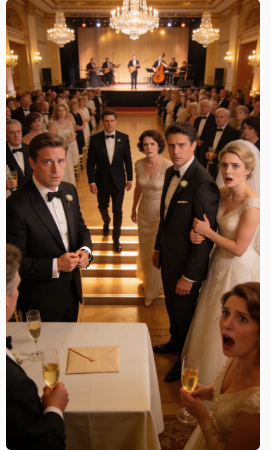
In the days surrounding these events, I kept a notebook with the date at the top of each page. I wrote down what I had seen myself, what someone had told me, and what I still needed to verify. Those categories became important. When a rumor traveled through the city, it often arrived dressed as a fact. I had once believed that a confident voice meant a person knew what they were talking about. The gala cured me of that illusion. I remembered Ximena's certainty as she held my mother's veil above her head. She had expected the room to accept her judgment because she was wealthy and beautifully dressed. The people who laughed had not asked whether she was right. They had merely decided that agreeing with her was safer than defending me.
My mother had a different measure of character. She used to tell me that the way a person behaved when nobody important was watching revealed more than a speech delivered beneath chandeliers. I thought about her words whenever I felt tempted to answer cruelty with cruelty. There were times I wanted to publish every ugly message, humiliate every person who had mocked me, and make the whole city choose a side. But anger was not a plan. I wanted the records corrected, the people responsible held accountable through a fair process, and the workers protected from the damage caused by their leaders. Those goals required patience I did not always possess.
At night, when the apartment was quiet, I sometimes opened the closet and touched the green satin. The fabric felt cool beneath my fingertips. I could picture my mother leaning over the sewing machine, her hair pinned back, one foot guiding the pedal while the other rested on the worn tile. She would have asked whether I had eaten dinner. She would have listened to my fears without telling me they were foolish. Then she would have reminded me that I had survived difficult things before. I missed that voice more than I missed the certainty that life would be simple.
I learned to accept help in small, unremarkable ways. Teresa brought groceries when I forgot to shop. Isabel reminded me to keep personal feelings out of formal statements. Javier called to tell me about a job opening when my contract was suspended. None of them could solve the entire problem. Each made it easier to face the next day. That was how I began to understand the difference between power and support. Power had allowed people to push my mother out of the story. Support helped me put her back where she belonged.
The bank officer gave me a moment alone with the photograph before asking whether I was ready to continue. I appreciated that courtesy. My mother's face in the picture was the face I remembered from childhood: determined, slightly amused, already thinking about the next problem to solve. I imagined her carrying the folders to the bank, perhaps hoping she would never need to explain them. She could not have known how much comfort I would take from seeing her handwriting again.
Later I copied the documents for Isabel and returned the originals to secure storage. I also made a separate folder of the things that were not legal evidence: recipes, notes about fabric, a list of songs she liked to play while sewing. I did not want the investigation to reduce her to a signature on a contract. She had been a whole person, and I needed room to remember that.
More chapters
You may like