Chapter 1 - THE MAN IN THE DARK

The voice came from the back of the ballroom, where the emergency lights made the older man's face look carved from stone. I knew him from photographs in the company's archives. Everyone in Monterrey knew him. Don Arturo Lombardo had founded the furniture business with a borrowed truck and a workshop no bigger than my mother's kitchen. For three weeks the company had insisted he was too sick to receive visitors. Yet there he stood, upright and furious, with a walking cane in one hand and a sealed envelope in the other.
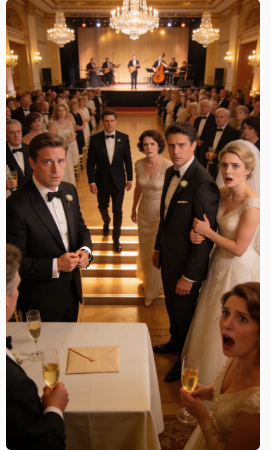
"Turn the lights back on," he ordered. The technicians obeyed before Renato could speak. Ximena still held the torn piece of my mother's veil. Her smile vanished. Arturo looked at the fabric, then at me. "That dress belonged to Lucía Reyes," he said. I felt the floor shift under my feet. "You knew my mother?" He nodded, and the grief in his eyes frightened me more than the humiliation had. "She saved this company," he said. "And I let men with expensive suits erase her name."
Ximena's father, Guillermo Salazar, pushed away from a table near the stage. He was the bank chairman who had financed the company's latest expansion. "Arturo, this isn't the place." The old man answered without looking at him. "It became the place when your daughter tore the last thing Lucía left her child." Renato stood between them, visibly shaken. I understood then that his warning to Ximena had not been an empty threat. He had been trying to prevent a confrontation he already knew was coming.
I wanted to leave. My dress hung unevenly from my shoulder, and every phone in the room seemed pointed toward me. But Arturo crossed the floor and offered me his arm. "Natalia, would you stand with me?" Nobody had spoken my name into a microphone that evening. I had been introduced only as a temporary logistics consultant, a woman who checked seating charts and solved problems no one else wanted. Hearing him say my name made people turn with fresh interest. I took his arm because my mother had taught me not to run from a room simply because somebody powerful wanted me gone.
Onstage, Arturo asked the anniversary video to be stopped. Instead, he told the guests that sixty years of success had been built on more hands than the official history acknowledged. My mother, he said, had designed the modular joint that made Lombardo furniture both beautiful and affordable. She had been eighteen when she first brought the prototype to his workshop. For years she received royalties through a private agreement. Then the payments stopped. The original contract vanished. My mother had never told me any of this.
Guillermo interrupted, insisting that Arturo was confused by medication. Arturo lifted his envelope. "A confused man doesn't spend six months collecting certified copies." Two men in dark suits appeared at the side door. One was a notary; the other introduced herself as attorney Isabel Cárdenas. Arturo said she represented a trust created decades ago for Lucía and her heirs. He did not announce what it contained. He merely told the room that the company would undergo an independent audit and that no executive would be allowed to destroy records.
Ximena threw the veil at my feet. "This is a publicity stunt," she hissed. I bent to pick it up, folding the damaged fabric carefully. My mother's stitches were still visible along the edge. When I straightened, I saw Renato watching me with a terrible expression, as if he wanted to apologize but knew apologies would not be enough.
Arturo's lawyer handed me a card and asked me to meet her the following morning. "Do not sign anything tonight," she whispered. "Especially if Mr. Salazar asks." That warning proved necessary before midnight. As I reached the hotel exit, a valet gave me a plain white envelope. Inside was a photograph of my mother standing beside Arturo and Guillermo, all three younger by decades. On the back, in my mother's handwriting, were seven words: If they say I agreed, ask why.
A second sheet had been tucked behind the photograph. It was a recent bank transfer, marked with my name as the beneficiary. The amount was more money than I had ever seen. I had never opened the account. Beneath it someone had written: THEY ARE USING YOU ALREADY.
Before I left the hotel, I walked through the service corridor where the catering staff were stacking empty trays. One of the servers offered me a clean napkin for my shoulder. He did not ask for my name or for the story behind the torn fabric. He simply noticed that I was cold. I thanked him and stood beneath the fluorescent light while he found a safety pin. His kindness was so ordinary that it almost undid me. In the ballroom, people had treated the dress as entertainment. In the corridor, a stranger treated it as something worth protecting. I remembered that distinction later, whenever the investigation tempted me to think that every person connected to the company was my enemy.
My phone buzzed with messages from people I barely knew. Some were sympathetic; others wanted details for their social media pages. I switched it off. Outside, the night air smelled of wet pavement and flowering trees. I sat in my car for several minutes before starting the engine, watching the illuminated hotel windows. I had entered the gala hoping to finish a consulting assignment and perhaps enjoy a good dinner. I was leaving with a ruined dress and a history I did not recognize. The city around me had not changed. Yet I felt as though a door had opened beneath my feet.
In the days surrounding these events, I kept a notebook with the date at the top of each page. I wrote down what I had seen myself, what someone had told me, and what I still needed to verify. Those categories became important. When a rumor traveled through the city, it often arrived dressed as a fact. I had once believed that a confident voice meant a person knew what they were talking about. The gala cured me of that illusion. I remembered Ximena's certainty as she held my mother's veil above her head. She had expected the room to accept her judgment because she was wealthy and beautifully dressed. The people who laughed had not asked whether she was right. They had merely decided that agreeing with her was safer than defending me.
My mother had a different measure of character. She used to tell me that the way a person behaved when nobody important was watching revealed more than a speech delivered beneath chandeliers. I thought about her words whenever I felt tempted to answer cruelty with cruelty. There were times I wanted to publish every ugly message, humiliate every person who had mocked me, and make the whole city choose a side. But anger was not a plan. I wanted the records corrected, the people responsible held accountable through a fair process, and the workers protected from the damage caused by their leaders. Those goals required patience I did not always possess.
At night, when the apartment was quiet, I sometimes opened the closet and touched the green satin. The fabric felt cool beneath my fingertips. I could picture my mother leaning over the sewing machine, her hair pinned back, one foot guiding the pedal while the other rested on the worn tile. She would have asked whether I had eaten dinner. She would have listened to my fears without telling me they were foolish. Then she would have reminded me that I had survived difficult things before. I missed that voice more than I missed the certainty that life would be simple.
I learned to accept help in small, unremarkable ways. Teresa brought groceries when I forgot to shop. Isabel reminded me to keep personal feelings out of formal statements. Javier called to tell me about a job opening when my contract was suspended. None of them could solve the entire problem. Each made it easier to face the next day. That was how I began to understand the difference between power and support. Power had allowed people to push my mother out of the story. Support helped me put her back where she belonged.
Before I left the hotel, I walked through the service corridor where the catering staff were stacking empty trays. One of the servers offered me a clean napkin for my shoulder. He did not ask for my name or for the story behind the torn fabric. He simply noticed that I was cold. I thanked him and stood beneath the fluorescent light while he found a safety pin. His kindness was so ordinary that it almost undid me. In the ballroom, people had treated the dress as entertainment. In the corridor, a stranger treated it as something worth protecting. I remembered that distinction later, whenever the investigation tempted me to think that every person connected to the company was my enemy.
My phone buzzed with messages from people I barely knew. Some were sympathetic; others wanted details for their social media pages. I switched it off. Outside, the night air smelled of wet pavement and flowering trees. I sat in my car for several minutes before starting the engine, watching the illuminated hotel windows. I had entered the gala hoping to finish a consulting assignment and perhaps enjoy a good dinner. I was leaving with a ruined dress and a history I did not recognize. The city around me had not changed. Yet I felt as though a door had opened beneath my feet.
More chapters
You may like